Who’s Serving? How to Keep Track of Server in Pickleball
To keep track of the server in pickleball, always announce the three-number score, Server Score, Receiver Score, and Server Number, before every serve. In doubles, the player on the right starts as Server 1 at each side-out.
To eliminate the scoring disputes caused by mental fatigue, modern players are shifting to Bluetooth 5.0 connected displays.
Tally’s 5.3 connected display, high-brightness LEDs, and four-level volume control ensure that the score is visible from feets away and audible across any court environment.
If you play pickleball regularly, you have probably heard this at least once during a game:
“Wait… who’s serving?”
It usually happens after a few quick rallies. Everyone is moving fast, laughing, switching sides, maybe chatting between points. Suddenly nobody is 100 percent sure of the score or which partner is the correct server.
Now the game pauses. You replay the last two points in your head. Someone disagrees. The rhythm breaks.
The frustrating part is that pickleball scoring is not actually complicated. It just depends heavily on memory, and memory fails when games get fast and social.
This guide explains, in plain language, how pickleball scoring works, how to remember who serves, and how to make scorekeeping simple for beginners, doubles teams, and competitive players alike.
How Does Keeping Score Work in Pickleball?
Official rules from USA Pickleball follow one core principle:
Only the serving team can score points.
Every rally ends in one of two ways:
• Serving team wins → they earn a point and keep serving
• Serving team loses → service rotates
Most recreational games are played:
• To 11 points
• Win by 2
Some leagues use 15 or 21, but the mechanics stay the same.
If you remember just one thing, remember this:
The serve controls the score.
Who is serving tells you exactly where you are in the game.
Why Do Players So Often Lose Track of the Server?
Before learning solutions, it helps to understand why this happens so frequently.
Common situations:
• Doubles rotation gets confusing
• Players forget to call the full score
• Fast rallies change points quickly
• Outdoor noise makes calls hard to hear
• Social games mean less focus on numbers
• No visible scoreboard
Picture a weekend open play session. Four players rotate partners every game. Someone shouts “six three” but forgets the server number. Two rallies later, nobody remembers whether it was first or second server.
This is not a rules problem. It is a visibility problem.
If the score only lives in people’s heads, mistakes are guaranteed.
How to Keep Score in Pickleball for Beginners
If you are just learning the game, start with a simple mental checklist instead of memorizing every technical detail.
Beginner rules that matter most
- Only servers score points
- Always say the score before you serve
- When your team loses a rally, the serve switches
- In doubles, both partners serve before the other team gets the ball
That is enough to play confidently.
What should you say before serving?
This is where many beginners slip.
Say the entire score clearly.
Not:
“Five three”
But:
“Five three one”
That third number matters.
Calling it out loud gives everyone a chance to catch mistakes before the ball is in play.
It is the simplest habit that prevents confusion.
Do Servers Count in Pickleball? What Does the Third Number Mean?
Yes. And this is the part that confuses most people.
In doubles, the score has three numbers:
Server score – Receiver score – Server number
Example:
6–4–2
That last number tells you which partner is serving.
How server numbers work
• First server = 1
• Second server = 2
Each team gets two chances to serve before a side-out.
The rotation pattern
Think of it like this:
First server → Second server → Opponents
Repeat.
Once you understand this cycle, you can almost always reconstruct who should be serving, even if you forget briefly.
One special exception
At the very start of the game, the first team only gets one server. After that, normal two-server rotation begins.
That small rule keeps games fair.
How Do You Remember Who Serves Without Overthinking It?
You do not need complicated math. You need cues.
Here are practical, on-court methods that actually work.
1. Always call the full score
This cannot be overstated.
Every point. Every serve.
Say all three numbers.
This single habit fixes most problems.
2. Use the “even right, odd left” rule
This is a powerful shortcut.
If your team score is:
• Even → serve from right side
• Odd → serve from left side
If you are standing on the wrong side, something is off.
This helps you self-correct instantly.
3. Talk to your partner
Quick reminders:
“You’re first server.”
“Second server now.”
Small communication beats silent guessing.
4. Make the score visible
Memory fails. Visibility does not.
When everyone can see the score, arguments disappear.
How to Keep Score in Pickleball Singles
Singles is much simpler because there is only one server per team.
Singles scoring format
Two numbers only:
Server score – Receiver score
Example:
8–6
How it works
• Only server scores
• Win rally → add point and switch sides
• Lose rally → side-out
Easy memory trick
Even score → right side
Odd score → left side
That rule alone keeps you oriented almost all the time.
Because there is no partner rotation, singles rarely has “who’s serving?” confusion.
How to Keep Score in Pickleball Doubles Step by Step
Doubles is where things get messy. Let’s slow it down.
Serving cycle example
At the very start of the game, the score is called as 0–0–2 so the first serving team only gets one server before a side-out.
Example starting sequence for Team A:
- Start: 0–0–2 – Player A1 serves from the right.
- A1 wins the rally → 1–0–2 (same server, switch sides).
- A1 wins again → 2–0–2 (same server, switch sides).
- A1 faults (loses rally) → side-out (serve goes to Team B; Team A used its one starting server).
From this point on, every time a team gets the serve, both partners will typically serve (as server 1 and server 2) before a side-out.
Example for a normal service turn later in the game (after the opening):
- Score: 2–1–1 – Team A’s first server (A1) serves from the right.
- A1 wins → 3–1–1 (A1 switches sides and serves again).
- A1 loses → 3–1–2 – now A2 becomes the server.
- A2 loses → side-out – serve goes to Team B.
Notice the pattern
- Win → your team scores and the server switches sides.
- First loss on a service turn → partner becomes the server (server 2).
- Second loss on that turn → side-out, and the other team serves.
It is rhythmic, almost like a loop. Once you recognize this pattern, you stop guessing.
Common doubles mistakes
- Forgetting which partner was the first server for the team.
- Skipping the third number when calling the score.
- Not switching sides after scoring on serve.
- Updating the score late or not at all before serving.
Fix those four habits and doubles becomes much easier.
One of the rarest but most helpful rules in pickleball is the Starting Side Rule(often called the First Server Exception or 0-0-2 Rule). The player who serves first for your team is tied to your score’s ‘Even’ or ‘Odd’ status for the entire game. If your score is 6 (even), and your starting server is on the left, you are out of position.
What About the “80 20 Rule” People Mention?
Some players talk about an “80 20 rule” in pickleball.
It is not an official scoring rule. It is a strategy concept.
It usually means:
• 80 percent of points are lost through unforced errors
• 20 percent are won through aggressive shots
In terms of scoring, this tells you something important.
Points change fast.
When rallies are short and mistakes happen quickly, the score moves rapidly. That makes it even easier to lose track if you rely only on memory.
The faster the game, the more important visible scoring becomes.
Is There a Way to Keep Score on a Phone or Apple Watch?
Yes. And more players are moving in this direction.
Instead of remembering numbers, they simply tap after each rally.
Benefits:
• Hands free
• Instant updates
• No mental math
• Fewer disputes
• Easier for leagues and tournaments
Especially during long sessions, digital tracking reduces fatigue.
It shifts scorekeeping from memory to confirmation.
Manual Scorekeeping vs Using a Connected Scoreboard
Here’s a deeper look at different ways people keep score today and how much mental work each approach requires.
| Method | How It Works | Typical Problems | Best For |
| Only verbal score calls | Server calls the score before each serve. | Misheard calls, forgetting server number, disagreements about score and rotation. | Very casual, tiny groups. |
| Phone or paper notes | Player tracks score on a phone app or pad. | Distracting to pull out device, not visible to others, slows down play. | Coaching, solo review, off-court tracking. |
| Flip or mechanical scoreboard | One player updates physical numbers. | Needs someone to manage it, not always readable at distance or in bright sunlight. | Small leagues, social events, rec centers. |
| Connected scoreboard + app | Score updated via phone/watch, shown on a board. | Requires a bit of setup and charging, but lowers on-court mental load. | Regular players, clubs, and league play. |
If you like the purity of calling your own score, manual methods are fine. But if you’re tired of the constant brainwork and arguments, a connected option can make scorekeeping fade into the background.
A More Reliable Way to Keep Score and Track Servers
Even when everyone knows the rules, real games get messy.
Friends talk between points. Courts are noisy. Rotations happen fast. Someone misses the call. Suddenly nobody agrees on the score.
This is exactly the frustration Tally was built to solve.
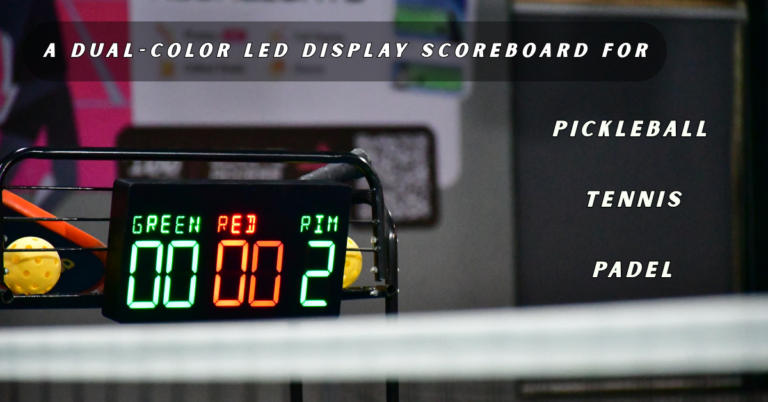
Tally Scoreboard is a portable, connected digital scoreboard and companion app designed specifically for points-based sports like pickleball.
It moves scorekeeping out of your head and into something everyone can see.
The Tally scoreboard

While most screens wash out in UV light, Tally features Hidden, Diffused LEDs concealed behind a frosted panel for smooth, glare-free visibility, even at high noon. This High Brightness technology ensures 50-foot legibility, while the dual-color Alpha-numeric display makes team names instantly recognizable.
• Ultra-bright, dual-color LED display visible in daylight
• Lightweight and easy to carry
• Hang on a fence or place courtside
• Durable for indoor and outdoor play
Everyone sees the score instantly. No shouting across courts.
The Tally Scoreboard mobile app
• Update scores in real time from your phone
• Sync wirelessly with the scoreboard
• Track past matches and results
• Keep all games in one placeGreat for leagues or players who like reviewing performance.
The Tally Scoreboard mobile app is available on both the App Store and playstore.

The Tally Scoreboard watch app
Tally creates a seamless connected ecosystem through wireless Bluetooth pairing. By using your Apple Watch as a remote, you can update the score from the baseline without walking to the net. The board stays in sync with the Companion App, allowing you to log past matches and analyze performance history.
• Tap your Apple Watch to update points
• No phone needed mid-rally
• Fast and hands free
• Perfect during competitive games
Imagine this scenario:
You are playing doubles on a busy Saturday morning. After each rally, you tap your watch. The scoreboard updates automatically. Both teams always know the score and server order.
Nobody asks, “What’s the score?” anymore.

That is Scoring Simplified. You never lose track of the score again.
If you would rather focus on rallies than remembering numbers, a portable, connected scoreboard like Tally makes every game smoother.
Quick On-Court Checklist
Before each serve:
• Call the full score
• Confirm server number
• Check your side (even or odd)
• Make sure everyone agrees
Or simply use a visible scoring system so there is nothing to remember.
Final Thoughts
Keeping track of who serves in pickleball is not about memorizing complex rules. It is about clarity. Call the score, follow the rotation, and make the numbers visible. When scoring is simple, the game flows better, stays fair, and is more fun for everyone.
Ready to stop guessing the score? Shop for Tally Scoreboard Now and keep every point clear, connected, and effortless.