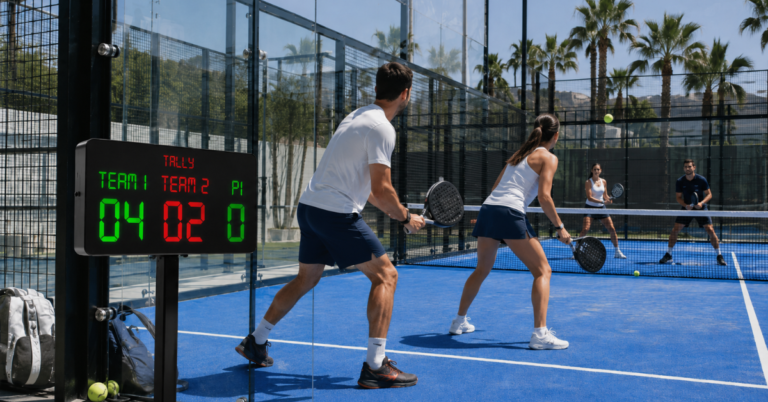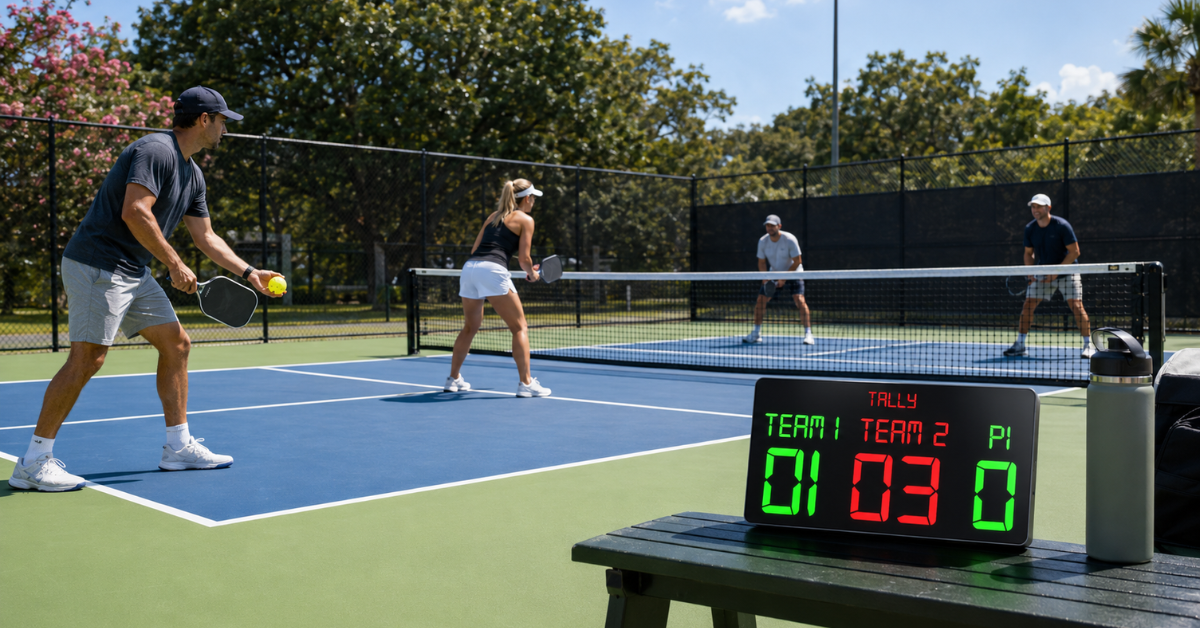
Summary: Learn how to keep score in pickleball with a clear step by step guide for doubles, singles, beginners, and tournament play. This guide explains pickleball scoring rules, the three number score call, server rotation, side outs, and how a portable digital scoreboard like Tally Scoreboard helps keep every match organized and dispute free.
To keep an accurate score in pickleball, you need four things in place before the first serve: a clear understanding of the three-number announcement, a server rotation system everyone can follow, a way to call the score out loud so both teams hear it, and a reliable method for tracking it visually. Get those right, and everything else, side-outs, server confusion, mid-game disputes, falls into place naturally.
Most players who say, “I don’t know how to keep score in pickleball,” are really saying they’ve never had the system broken down step by step. The rules look messy at first because pickleball borrows ideas from tennis and badminton, but builds its own logic on top. Once you see the pattern, you’ll never need to ask “what’s the score?” again.
Why Keeping Score in Pickleball Matters More Than You Think
A well-called score does more than settle the math. It sets the pace of the match, prevents arguments before they start, and signals to incoming players how close the game is to finishing. Most casual matches lose their flow not because of bad play but because the score breaks down mid-game, and the rest of the match becomes a debate about what it should be.
The catch? Most players underestimate two things: the doubles rotation logic and how quickly fatigue erases short-term memory. This guide fixes both. Whether you’re learning to call a pickleball game for the first time, running a community open-play session, or organizing a weekend bracket, the steps below will carry you through every scoring scenario you’ll encounter.
Learn the Three-Number Announcement in Pickleball
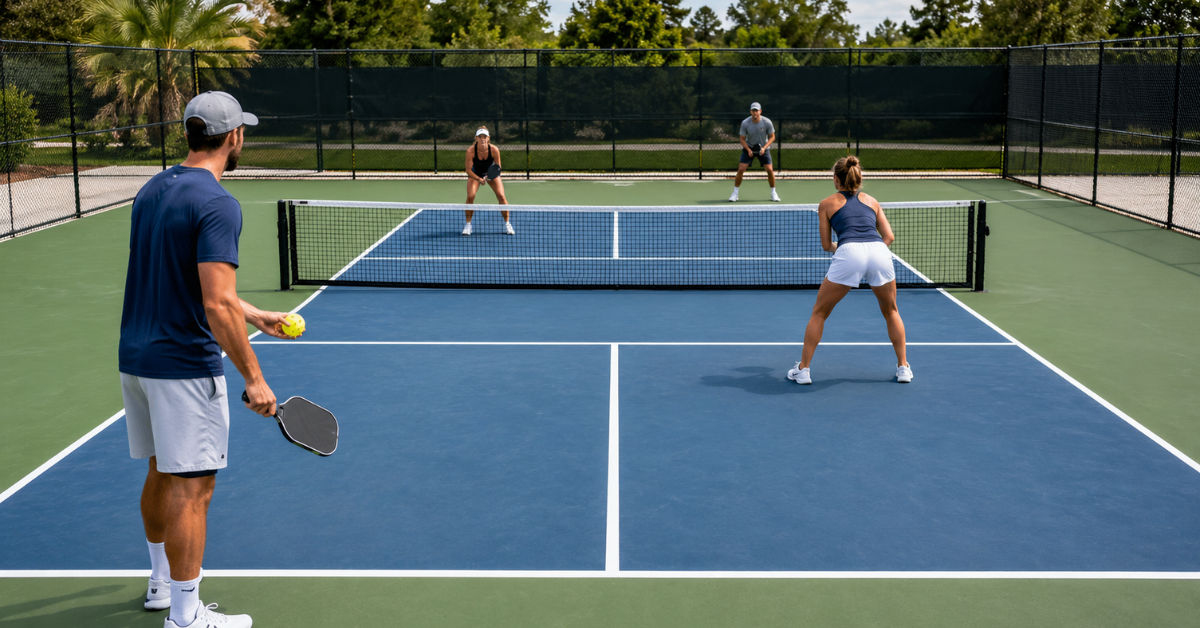
Before you can keep score in pickleball, you need to understand what the three numbers actually represent. The official scoring framework comes from USA Pickleball, and the announcement structure is the same across every recreational and sanctioned tournament that uses traditional side-out scoring.
A quick primer:
The three numbers in doubles are called before every serve:
- First number: Serving team’s score
- Second number: Receiving team’s score
- Third number: Server number (1 or 2)
A call of “6-3-2” means the serving team has 6 points, the receiving team has 3, and the second server is at the line. Singles play drops the third number because there’s no server rotation between partners.
The key rules to know:
- Games are played to 11, win by 2
- Only the serving team can score points (in side-out scoring)
- The first server of every new game starts on the right-hand side of the court
- The starting team gets only one server before a side-out; every team after that gets two
If your group mixes new and experienced players, post a one-page version of these rules at the court before the first match. It prevents 90% of mid-game confusion before it starts.
For a deeper look at how pickleball scoring compares to other racket sports, this breakdown of pickleball, padel, paddle, and tennis differences is a useful reference to share with players from different backgrounds.
Master How to Keep Score in Pickleball Doubles
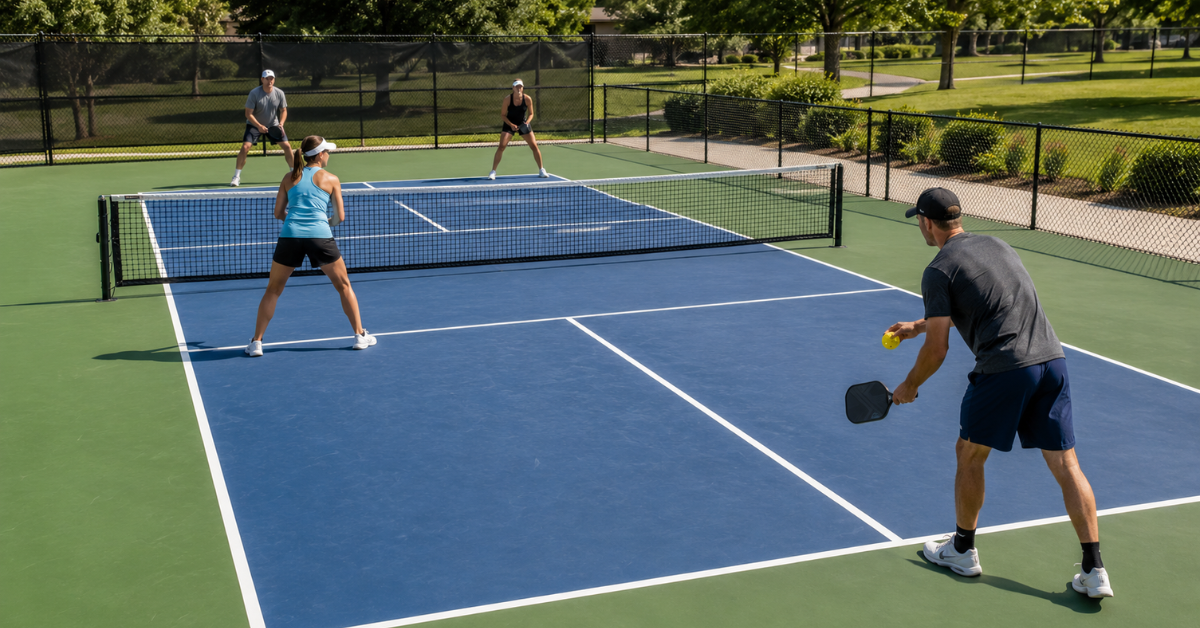
Doubles is where most players get confused. If you are searching for how to keep score in pickleball doubles, focus on two ideas: server number and court position.
The doubles serve sequence:
- The serving team wins a rally → the same player serves again and switches sides with their partner
- The serving team loses a rally → the second server takes over without switching sides
- Both servers on the team have lost → side-out, the other team serves
The even-odd court position rule:
This is the most useful sanity check in all of pickleball scoring. The server with an even score serves from the right-hand court. The server with an odd score serves from the left-hand court. If a player is about to serve from the wrong side, the score has been miscounted somewhere. Work backward from the position to find the correct count.
The “starting as server one” ritual:
Doubles partners forget who is server 1 and who is server 2 more often than any other scoring error. The fix is simple: at the start of every game, the first server declares “starting as server one,” so the rotation is anchored to a clear reference. Combine that with the even-odd court position rule, and most doubles scoring confusion disappears.
How to Keep Score in Pickleball Singles
Learning how to keep score in pickleball singles is much easier than doubles because there is no partner rotation.
Singles scoring at a glance:
- The score is announced as two numbers: server score, receiver score
- The serving player keeps serving until they lose a rally
- After a loss, the serve transfers directly to the opponent
- The even-odd court position rule still applies (even score = right court, odd score = left court)
- Games run to 11 with a 2-point margin in most recreational play
If you’re coaching someone new to the sport, start them with singles before introducing doubles scoring. The mental load is lower, and the rotation rules are easier to learn in stages.
Avoid the Five Most Common Scorekeeping Mistakes
Most score disputes come from the same five mistakes. Knowing what to watch for is half the fix. The first three mistakes are about discipline. The last two are about infrastructure. Once you have both in place, the entire scoring experience changes.
| Mistake | Why It Happens | Quick Fix |
| Forgetting the score mid-rally | Fatigue compromises short-term memory | Announce before every serve, pause for confirmation |
| Confusing server 1 and server 2 | No clear starting reference | Declare “starting as server one” at game start |
| Serving from the wrong side | The score was miscounted earlier | Use the even-odd court position check |
| Disagreeing on the count | No visible scoreboard or written record | Set up a visible score display before the match |
| Losing match history | Paper sheets get lost or are never written on | Track scores in a connected app that logs results automatically |
Set Up a Reliable Score Tracking System
This is the step most players skip, and it’s also the one that pays the biggest dividend. A reliable tracking system means three things working together: a clear verbal call, a visible digital pickleball scoreboard everyone can see, and a digital record of every match.
For verbal calls:
- The server announces all three numbers before every serve
- The call is loud enough for both opponents to hear
- The receiving team gets a brief pause to confirm or correct the call
For visible scoreboards:
- Manual flip cards work for casual play but fail in multi-court settings
- Peg boards require someone to walk over and update after every point
- Connected digital scoreboards update instantly from a phone or smartwatch
For digital records:
- A companion app logs every match automatically
- Match history is searchable after the session
- Performance trends become visible across weeks and months
How a Digital Pickleball Scoreboard Helps Players
This is the point where most players realize manual scoring isn’t keeping up with how they actually play. Long rallies blur the count. Multi-court sessions make verbal calls impossible to hear across courts. Paper sheets get lost between games.
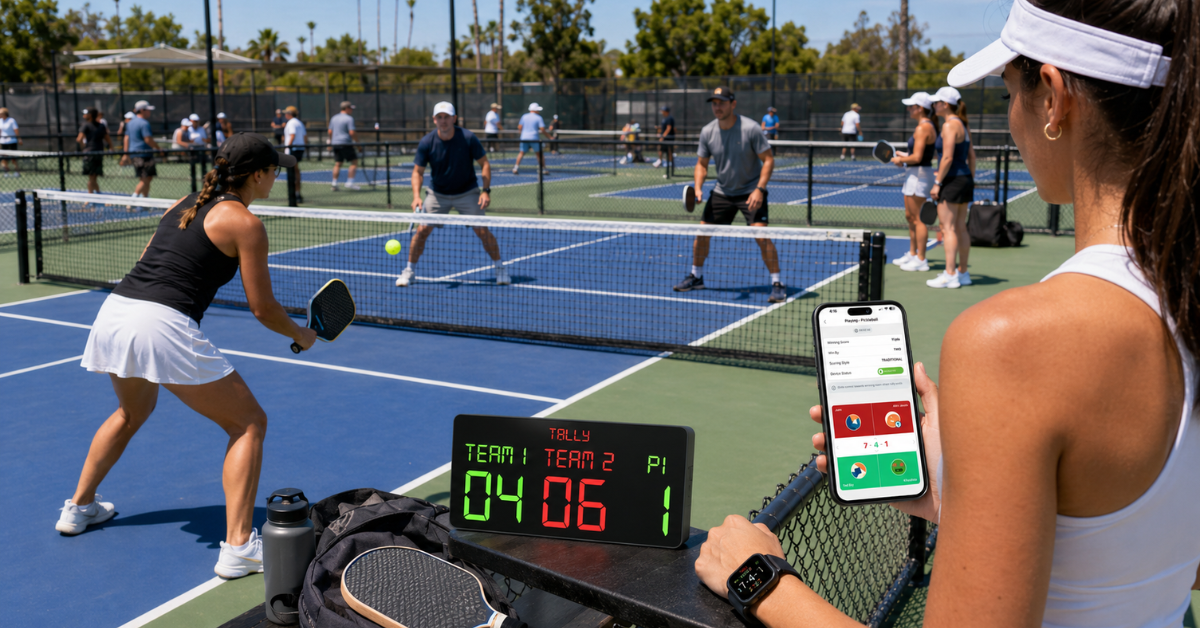
A portable pickleball scoreboard, connected, removes most of this friction. Tally is a compact LED portable digital scoreboard that connects to your phone or Apple Watch via Bluetooth, letting you update the score from anywhere on the court without walking back to a table. The dual-color LED display is readable outdoors, and the companion app (iOS and Android) logs scores in real time and stores match history so you have a record of every result at the end of the day.
A connected scoreboard like Tally keeps the count visible to everyone on the court, syncs to phones and smartwatches in real time, and stores every match in the companion app.
The hardware is built for the way pickleball is actually played: 14 by 8 by 2 inches, 2.2 pounds, up to 8 hours of battery on a single USB-C charge, and a reliable Bluetooth connection within 30 feet of the court. The app works across iOS, Android, and Apple Watch, so whoever is closest to the scoreboard can update it without breaking the flow of the game.
In a multi-court session, this matters more than it sounds. When one device handles scoretracking for an entire afternoon with nothing to configure between matches, the energy stays on the court where it belongs.
For a closer look at the operational difference between manual and connected scoring, this comparison of manual vs. digital scoreboards lays out the trade-offs clearly across different settings.
Apply These Rules to Tournament Play
Tournament-level pickleball scoring works on the same rules as recreational play, but the stakes are higher, and the margin for error is smaller.
Before the event:
- Confirm the format with all players (round robin, single elimination, double elimination, or pool play + knockout)
- Decide the game length (games to 11, 15, or 21, depending on bracket)
- Post a one-page rules summary at every court
- Designate a court marshal who can resolve disputes
During the event:
- Use a visible scoreboard at every active court
- Update the bracket immediately after each match completes
- Cap matches in round-robin formats to keep the schedule on track
- Record final scores in a connected app so results flow into standings without paper
For multi-court setups:
- One device per court is the minimum
- Live standings should be visible to waiting players
- Tiebreaker rules (point differential, head-to-head) must be set before the event starts
The Tally case study from tournament play at Allegheny Country Club walks through how a single club shifted to fully digital scorekeeping and the operational outcomes that followed.
Multi-sport facilities running pickleball alongside tennis or padel benefit even more from connected systems; the Tally guide to switching scoring logic across padel, tennis, and pickleball covers how the same court and the same device can host three different sports without any reset.
Quick Reference: Pickleball Scoring at a Glance
| Format | Score Announcement | Games To | Server Rotation |
| Doubles (side-out) | Three numbers: serving, receiving, server number | 11, win by 2 | Both partners serve before side-out |
| Singles (side-out) | Two numbers: server, receiver | 11, win by 2 | Serve transfers on every loss |
| Rally scoring | Two numbers, points on every rally | 15 or 21 | Same as format above |
| Tournament play | Same as format, often longer games | 11, 15, or 21 | Set by tournament rules |
Keep the Score Clear and the Game Moving
A great pickleball match comes down to four honest decisions: knowing the format, calling the score clearly, tracking the rotation, and using a system that everyone on the court can see. Get the basics right, post the rules before the first serve, and have a clear way to record and display the score in real time.
The goal isn’t to turn every backyard game into a sanctioned tournament; it’s to give everyone competitive matches, minimal downtime, and zero arguments about the count. With a solid grasp of the rules and the right scoring system, that’s entirely achievable from the first rally to the final point.
→ Want to stop mid-game arguments and start keeping clean records? See how Tally keeps every point visible and connected.

Team Tally is the collective voice behind Tally, covering topics related to scorekeeping, match tracking, and connected scoring technology for pickleball, tennis, padel, platform tennis, cornhole, and other points-based games. The team shares insights and updates focused on making scoring simpler, more accurate, and easier to manage during play.