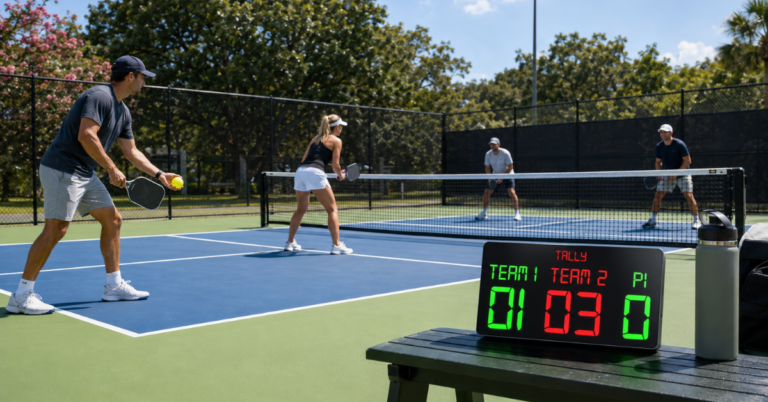
Summary: This beginner’s guide explains how to score padel from the first point to match point. It covers how points count (15, 30, 40, game), how to win games and sets, the tiebreak, and the deuce options you will actually see on court — traditional advantage, the golden point, and the new 2026 Star Point. It also walks through padel’s underhand serving rules and how to call the score, then shows how a portable digital scoreboard keeps everyone on the same page.
Padel uses the same scoring system as tennis. You count points as 15, 30, 40, and a game if you win six games to take a set, and play the best of three sets to win the match. The biggest differences are that padel is played almost entirely in doubles, and many matches use a faster “golden point” instead of long deuces.
So if you already know tennis, you know most of the padel scoring. If you are brand new, this guide walks through it step by step: points, games, sets, the golden point, the tiebreak, and how serving works so you can keep score confidently from your very first match. It is also one of the reasons racquet and paddle sports are growing so fast: the rules are easy to pick up.
Padel Scoring at a Glance (Quick Answer)
Here is the whole system in four lines:
- Points: 15, 30, 40, then game (zero is called “love”)
- Game: the first team to 4 points, winning by at least 2
- Set: the first team to 6 games, winning by at least 2
- Match: the first team to win 2 out of 3 sets
Everything else below is just the detail behind those four lines.

How Padel Scoring Works: Points, Games, and Sets
Points
Within a single game, points are counted 15, 30, 40, and then the game is won. A score of zero is called “love.” So the first point makes it 15, the second 30, the third 40, and the fourth wins the game as long as your team is ahead by two points.
Games
Winning four points wins a game, but you must win by two clear points. If both teams reach 40, the score is tied at “deuce,” and the game continues until one team is two points ahead (more on that and the faster golden point below).
Sets
The first team to win six games wins the set, again by a margin of at least two games. If the set reaches 5-5, you play on to 7-5; if it reaches 6-6, the set is decided by a tiebreak.
Match
A padel match is normally the best of three sets, so the first team to win two sets wins the match. According to the International Padel Federation (FIP) rules of padel, this point-game-set-match structure is shared directly with tennis.

Deuce, the Golden Point, and the New Star Point
When both teams reach 40, the game is tied at deuce, and this is where padel offers a few options that beginners should know about.
Traditional advantage
In the classic method, after deuce, a team must win two points in a row to take the game. Win the first, and you have “advantage”; win the next, and you take the game. Lose it, and the score returns to deuce. Games can go on for a while this way.
The golden point
To keep matches fast and competitive, most competitive and recreational padel uses the golden point: at deuce, a single deciding point is played with no advantage. Whoever wins that one point wins the game. The receiving team chooses which side will return the serve. The golden point has been standard on the professional Premier Padel tour and is popular in clubs because it keeps games moving.
The Star Point (new for 2026)
In January 2026, the FIP introduced the “Star Point” as a middle ground. At 40-40, up to two advantages are allowed; if neither team closes out the game, a single deciding point settles it. It blends the drama of advantage play with the speed of the golden point. Check whether your club or league uses traditional advantage, golden point, or the Star Point before you start — it changes how deuces are played.
The Padel Tiebreak Explained
If a set reaches 6-6, it is decided by a tiebreak. The first team to reach 7 points wins the tiebreak, provided they lead by at least 2 points; if not, play continues until one team is 2 points ahead. During the tiebreak, points are counted as simple numbers (1, 2, 3…) rather than 15, 30, 40, and the serve rotates every two points.
How Serving Works in Padel
Serving is where padel clearly differs from tennis. The serve is always underhand and follows a few specific rules:
- The server must bounce the ball once on the ground behind the service line before hitting it
- The ball must be struck at or below waist height
- The serve is hit diagonally into the opposite service box
- As in tennis, you get two serve attempts
These serving rules come straight from the official padel rules, and they are worth practicing early because a legal serve is the foundation of a clean game.
How to Call the Score in Padel
Calling the score in padel is simple once you know the order: always say the serving team’s score first, then the receiving team’s. Use “love” for zero, and say “deuce” when both teams reach 40. For example, if the serving team has won two points and the receiving team one, you would call it “30-15.” Saying the score out loud before each serve keeps everyone aligned and prevents disputes.
Padel Scoring vs Tennis Scoring
The point, game, and set structure is identical to tennis, which is why the two are so easy to confuse. The real differences are that padel is played only in doubles, most padel games use a golden point or Star point to speed up deuces, and the walls are part of play (though they do not change how you score). If you play more than one racquet sport, our guide to the differences between pickleball, padel, paddle, and tennis scoring breaks down all four side by side.
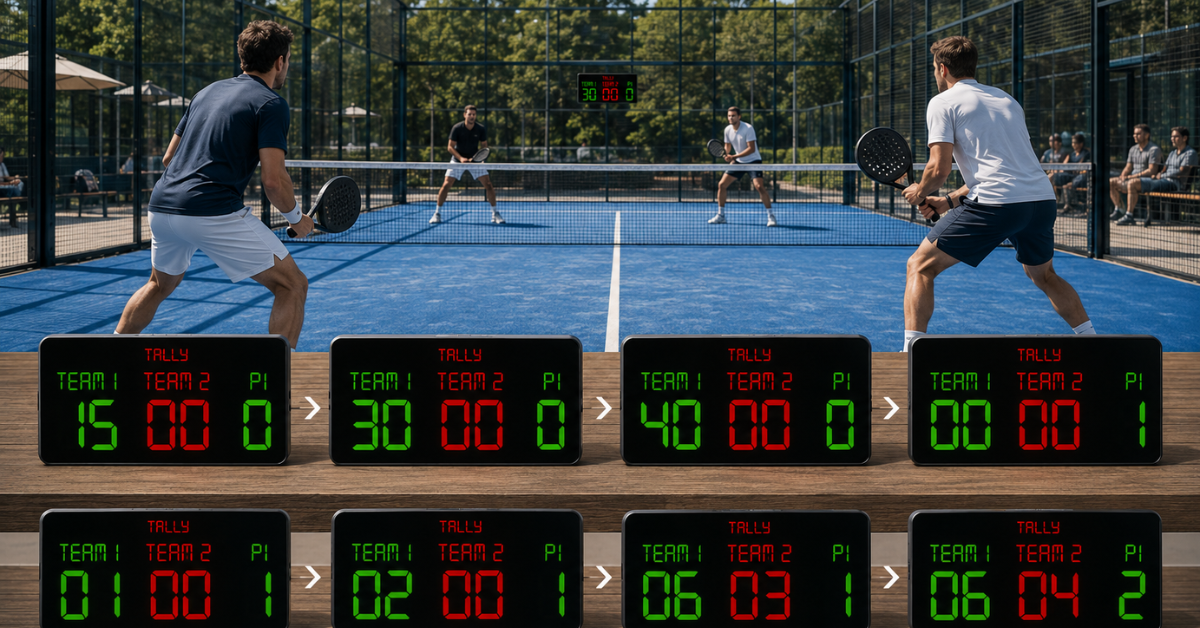
Keep Score Easily with a Portable Scoreboard
Padel scoring is simple to learn but easy to lose track of during fast rallies — especially with golden points and tiebreaks in play. That is exactly the kind of common scorekeeping problem a shared, visible scoreboard solves.
Tally is a portable digital scoreboard with a built-in padel format, so the display follows padel’s points, games, and sets automatically no mental math. It helps you:
- Score padel, pickleball, tennis, and platform tennis with the correct format for each
- Control the score from your phone or smartwatch, so no one has to remember it
- Show a bright, dual-color, anti-glare LED display that both teams can read outdoors
- Set custom team names and share one score everyone trusts
If you switch between sports on the same court, our guide on how to switch scoring logic between padel, tennis, and pickleball shows how a single scoreboard handles all of them.
Key Takeaways
Padel is scored just like tennis: points count 15, 30, 40, game, and zero is “love.”
You win a set with six games (by two), and a match is the best of three sets.
At deuce, padel may use traditional advantage, the golden point, or the new 2026 Star Point check, which your club uses.
Serving is underhand: bounce the ball first, hit it at or below waist height, and serve diagonally.
A portable digital scoreboard with a padel format keeps the score visible and dispute-free.

Team Tally is the collective voice behind Tally, covering topics related to scorekeeping, match tracking, and connected scoring technology for pickleball, tennis, padel, platform tennis, cornhole, and other points-based games. The team shares insights and updates focused on making scoring simpler, more accurate, and easier to manage during play.