Table of Contents
TL;DR: The Racket Sport Breakdown
While they all involve hitting a ball over a net, Tennis, Padel, Paddle Tennis, and Pickleball are distinct sports with unique rules:
- Tennis: The “Grandfather” sport. Uses the largest court, strung rackets, and high-pressure balls. It has the steepest learning curve and uses the classic 15-30-40 scoring system.
- Padel: A “Squash-Tennis” hybrid. Played in an enclosed glass court where the walls are in play. Uses solid, perforated paddles and tennis-style scoring (often with a “Golden Point” at deuce).
- Paddle Tennis: A scaled-down version of tennis. Played on a smaller, open-air court with solid paddles and depressurized balls. It keeps traditional tennis scoring but is more accessible.
- Pickleball: The fastest-growing favorite. Uses a plastic wiffle ball, a small court, and the famous “Kitchen” (no-volley zone). Unique scoring: you can only score while serving, and doubles teams use a three-number score call (e.g., 4-2-1).
The Bottom Line: If you want ease of entry, go Pickleball. If you want a high-energy strategy with walls, try Padel. If you want a classic challenge, stick to Tennis.
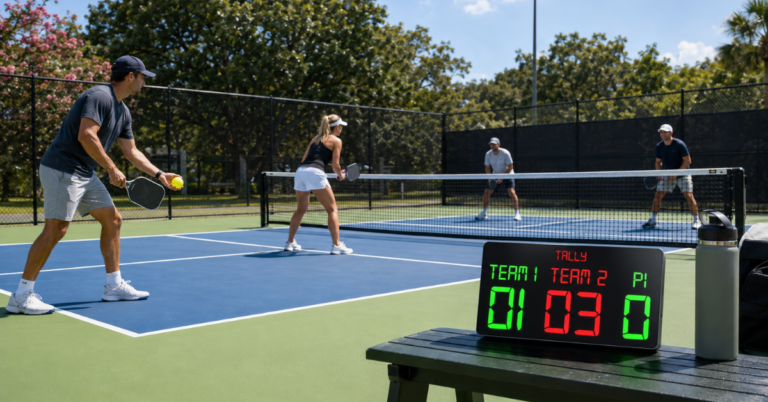
Pro Tip: Keep the game friendly and avoid scoring arguments by using a multi-sport digital scoreboard like Tally.
So you’ve heard people talking about pickleball at the gym. Someone else is raving about padel on Instagram. Your neighbor keeps mentioning paddle tennis. And then there’s regular tennis, which has been around forever and needs no introduction.
Are these all the same sport with different branding? Not even close.
If you’ve ever stood courtside, genuinely confused about what game was being played, or worse, tried to keep score in the wrong format, this is your guide. We’re breaking down all four sports: what makes each one unique, how the courts differ, what gear you use, and most importantly, how scoring works in each one. Because scoring is where things get really different.
Wait, Why Are There So Many Paddle Sports Now?
Great question. The short answer is that each of these sports scratched a slightly different itch at a different moment in history.
- Tennis has been around since the 1870s and is the grandfather of all racket sports.
- Paddle tennis was developed in the early 1900s as a more accessible, compact version of tennis, with smaller courts, solid paddles, and no strings.
- Padel was invented in Mexico in the 1960s by Enrique Corcuera and exploded in popularity across Spain and Latin America before going global.
- Pickleball was literally invented in 1965 by three dads on Bainbridge Island, Washington, who were trying to entertain their kids using ping-pong paddles, a wiffle ball, and a badminton net. It’s now one of the fastest-growing sports in the US, with over 223.5% growth in participation over three years, according to the SFIA.
Each sport evolved with different equipment, different court sizes, and here’s the part that trips people up, completely different scoring systems.
The Courts: Size Matters More Than You Think
Before the scoring even starts, the physical space you’re playing in shapes the entire experience of the game.
Tennis has the biggest court: 78 feet long and 36 feet wide for doubles. If you’ve played tennis, you know how much ground you cover.
Padel courts are smaller, about 32.8 x 65.6 feet, but what really sets them apart is the enclosure. Glass walls and wire mesh surround padel courts, and the ball can legally bounce off those walls. Think squash crossed with tennis. The walls aren’t obstacles; they’re part of the game.
Paddle tennis courts sit between the two: 50 feet long and 20 feet wide. The net sits at 31 inches in the center. There are no walls; it’s open air, like a compact tennis court.
Pickleball courts are the smallest of the group: 44 feet long and 20 feet wide, roughly the same dimensions as a doubles badminton court. But here’s the thing that surprises a lot of newcomers: there’s a 7-foot “kitchen” (officially called the non-volley zone) on both sides of the net where you cannot volley the ball. That zone changes everything about how the game is played near the net.
The Equipment: Paddles, Rackets, and Balls That Are Not Interchangeable
You might see someone holding what looks like a paddle and assume all four sports use the same thing. They don’t.
Tennis uses strung rackets, the springy, wide-faced frames you’ve seen forever. The ball is felt-covered, pressurized, and built for speed.
Padel uses a solid, perforated paddle (called a pala) typically made from carbon fiber. The ball looks like a tennis ball but with less pressure, so it doesn’t bounce as high or travel as fast.
Paddle tennis uses a solid, stringless paddle smaller than a padel paddle, along with a depressurized tennis ball that bounces lower than a standard one. The feel is firm and tennis-like.
Pickleball uses a flat, solid paddle (sometimes made from graphite, fiberglass, or composite materials) and a plastic perforated ball, essentially a wiffle ball. Because of those holes, the ball moves more slowly and is significantly affected by wind outdoors. This slower pace is actually a design feature: it forces players to rely on placement and finesse rather than raw power.
How Scoring Works in Each Sport
This is the part that genuinely confuses people, especially when someone’s keeping score on a shared court.
Tennis Scoring
Tennis uses a system most people recognize, even if they don’t fully understand it:
- Points go: 0 (love) → 15 → 30 → 40 → Game
- Win a game, and you work toward winning a set (usually first to 6 games, win by 2)
- Win enough sets, and you win the match
- If both players reach 40-40, that’s called deuce, and you need to win two consecutive points. First to win gives you “advantage,” second gives you the game.
It’s beautiful, structured, and slightly old-fashioned, and it takes a while to learn if you’re brand new.
Padel Scoring
Padel uses almost the same scoring system as tennis (15, 30, 40, game, sets, match). The main difference: when a game reaches deuce (40-40), there’s no “advantage”; the next point wins. Some call it the “Golden Point” rule. It keeps games moving. Padel is typically played as a best-of-three set format, almost always in doubles.
Paddle Tennis Scoring
Paddle tennis also follows traditional tennis scoring sets, games, and the same point structure (15, 30, 40, game). Unlike pickleball, both the serving and receiving sides can win a point during any rally, which means pressure is shared across both teams. It’s familiar to anyone coming from a tennis background.
Pickleball Scoring
This is where things get interesting and, honestly, where score disputes happen most.
Pickleball uses rally scoring to 11 points (win by 2). But here’s the key rule that trips people up:
Only the serving team can score a point.
If the serving team wins the rally, they score a point. If the receiving team wins the rally, they don’t get a point; they just earn the serve back.
In doubles, each partner gets a turn to serve before the serve switches to the other team (with one exception at the very start of the game, where only one player serves to balance things out). When you call the score in pickleball doubles, you announce three numbers: your score, the opponent’s score, and whether you’re the first or second server.
So you might hear: “4-2-1,” meaning the serving team has 4 points, the receiving team has 2, and it’s the first server’s turn.
The double-bounce rule is another uniquely pickleball mechanic: after a serve, each team must let the ball bounce once on their side before they can start volleying. This prevents players from rushing the net immediately and smashing the ball, which encourages longer, more strategic rallies.
Quick Comparison: All Four Sports Side by Side
| Tennis | Padel | Paddle Tennis | Pickleball | |
| Court Size | 78′ x 36′ | 65.6′ x 32.8′ (enclosed) | 50′ x 20′ | 44′ x 20′ |
| Equipment | Strung racket + felt ball | Solid perforated paddle + low-pressure ball | Solid paddle + depressurized ball | Solid paddle + plastic wiffle ball |
| Walls? | No | Yes | No | No |
| Scoring | 15-30-40-game, sets, match | Same as tennis (no advantage at deuce) | Same as tennis | 11 points, win by 2; serving team only scores |
| Serves | Overhand, bounce optional | Underhand, must bounce first | Underhand with bounce | Underhand, below the waist |
| Non-volley zone? | No | No | No | Yes (7-foot “kitchen”) |
| Typical Format | Singles or doubles | Doubles only | Singles or doubles | Singles or doubles |
Which Sport Has the Steepest Learning Curve?
If you’re brand new to racket sports:
Pickleball is generally considered the easiest to pick up. Smaller court, slower ball, simple rules to start (scoring comes later), and it’s genuinely fun from your very first game. The kitchen rule adds strategy as you improve.
Padel is beginner-friendly in terms of rallying; the walls give you more chances to recover, but the scoring system (borrowed from tennis) can confuse newcomers.
Paddle tennis sits comfortably in the middle: accessible for casual players, but with more physicality and footwork than pickleball.
Tennis has the highest barrier to entry: a bigger court, a faster ball, more complex scoring, and a service motion that takes real practice to develop.
The Scoring Problem Nobody Talks About
Here’s something every recreational player deals with eventually: losing track of the score mid-game.
Tennis has its 15-30-40 system, which is actually pretty hard to forget once it’s in your head. But pickleball? Calling a three-number score while your heart rate is up, in the middle of a rally rotation, in doubles? It happens to everyone.
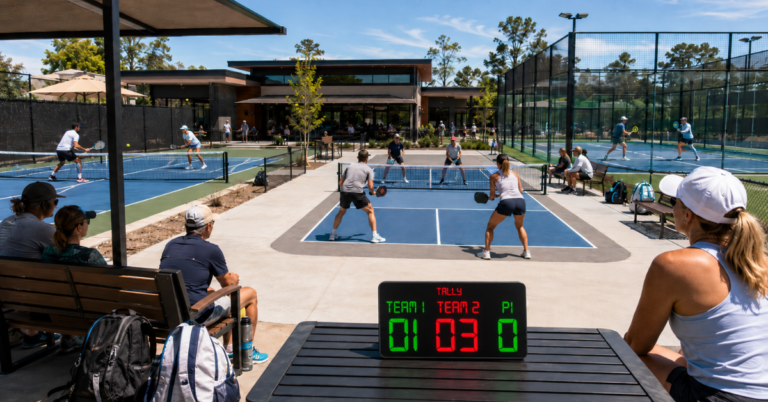
This is exactly why a reliable, visible scoreboard isn’t a luxury; it’s a game-changer. When the score is displayed clearly for everyone on the court to see, disputes disappear. You stop the mental overhead of remembering the score and start focusing on playing.
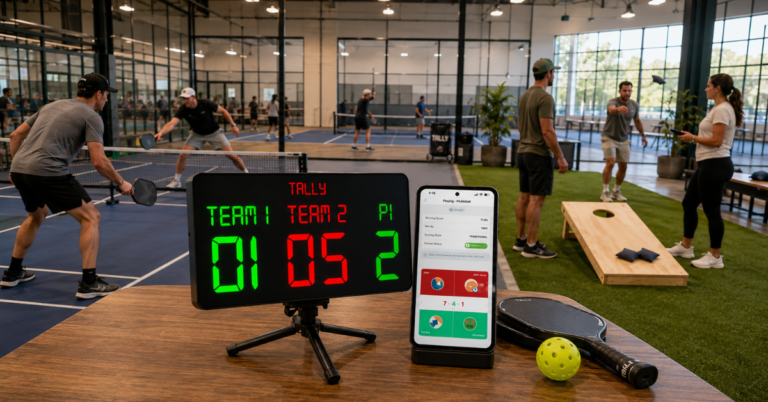
At Tally, we built a scoreboard that handles multi-sport scoring natively, including the unique serving-side tracking that pickleball requires. You can switch between sport scoring modes on the fly, which matters when your court hosts morning pickleball, afternoon padel drills, and an evening tennis match. Smart scoring for recreational sports isn’t just about convenience; it’s about keeping the game fair and keeping your focus on playing.
So Which Sport Should You Try?
Honestly? Try all of them if you can. Each one offers something genuinely different.
- If you love long strategic rallies and angles: Padel
- If you want high social energy, quick games, and a low barrier to entry, Pickleball
- If you’re already a tennis player and want something compact: Paddle tennis
- If you want the real deal with history, prestige, and the deepest skill ceiling: Tennis
The courts are getting more crowded. The paddles are getting lighter. And the score is finally getting easier to track.
Want to stop arguing about the score and start actually playing? Explore Tally’s multi-sport digital scoreboard built for pickleball, padel, tennis, and more.
Frequently asked Questions
Can I use a tennis ball to play pickleball or padel?
No. Each sport requires a specific ball. Pickleball uses a perforated plastic “wiffle” ball; Padel uses a ball that looks like a tennis ball but has lower pressure; and Tennis uses a high-pressure, felt-covered ball. Using the wrong ball will change the physics of the game and could damage your equipment.
Is the scoring the same for Padel and Tennis?
They are very similar (15, 30, 40, Game), but there is one key difference. While Tennis usually uses “Advantage” at deuce, Padel often uses a “Golden Point” (no-advantage) rule where the winner of the next point after 40-40 wins the game immediately.
What is the “Kitchen” in pickleball, and do the other sports have one?
The “Kitchen” is the 7-foot non-volley zone on both sides of the pickleball net. Players cannot hit a volley (a ball out of the air) while standing inside this zone. Tennis, Padel, and Paddle Tennis do not have this rule.
Why is pickleball scoring so different from the others?
Unlike Tennis, Padel, or Paddle Tennis, where either side can win a point regardless of who served, Pickleball typically uses “side-out” scoring. This means you can only score a point when your team is the one serving.
What is the main difference between Padel and Paddle Tennis?
The biggest difference is the court enclosure. Padel is played on a court surrounded by glass and mesh walls that are “in play” (like squash). Paddle Tennis is played on an open-air, smaller version of a tennis court with no walls.
Which is easier to learn: Pickleball or Tennis?
Pickleball has a much lower learning curve. Because the court is smaller, the paddle is easier to handle than a long racket, and the ball moves more slowly, beginners can usually play a competitive game on their first day. Tennis requires more technical skill, especially for the overhand serve.
Can you play Padel as a singles match?
While singles courts exist, Padel is almost exclusively a doubles sport. The strategic use of the walls and the court dimensions are specifically designed for 2v2 play.

Team Tally is the collective voice behind Tally, covering topics related to scorekeeping, match tracking, and connected scoring technology for pickleball, tennis, padel, platform tennis, cornhole, and other points-based games. The team shares insights and updates focused on making scoring simpler, more accurate, and easier to manage during play.