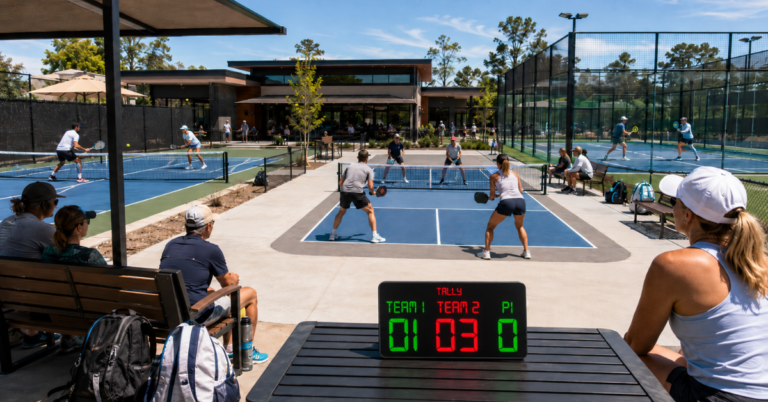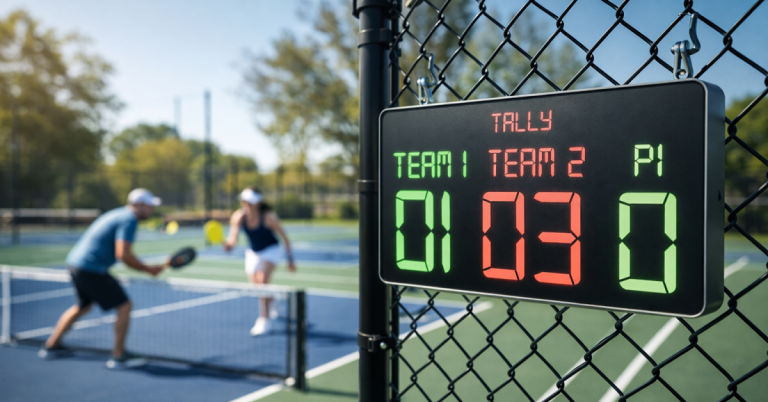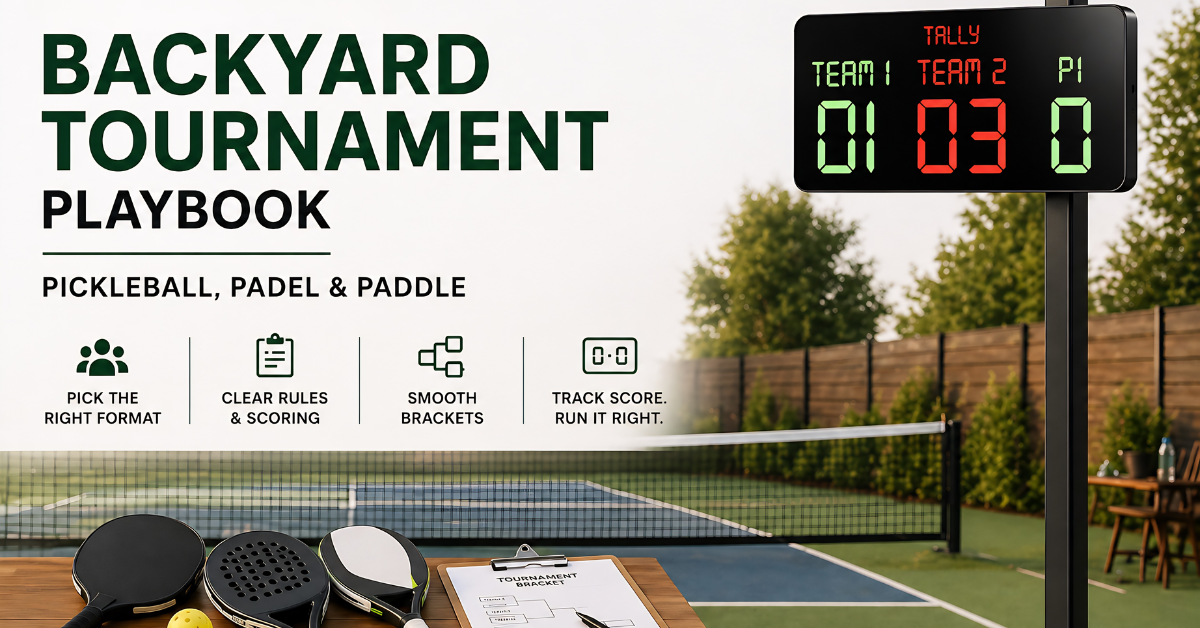
Summary: A smooth backyard pickleball, padel, or paddle tournament depends on four decisions: player count, format, scoring clarity, and score tracking. Poor format and weak scorekeeping are the biggest reasons events break down.
To organize a successful backyard pickleball, padel, or paddle tournament, you need four things in place before the first rally: a player count, a format (round robin or single elimination), clear scoring rules, and a reliable way to track the score. Get those right, and everything else, brackets, rotation, tie-breakers, falls into place naturally.
Why Backyard Tournaments Are Worth the Effort
A well-run neighborhood tournament does more than fill an afternoon. It builds a regular playing group, introduces new players to structured formats, and gives competitive players a low-stakes environment to test their game. The catch? Most DIY tournaments lose steam mid-event because the organizer underestimated two things: format choice and scoretracking.
This guide fixes both. Whether you’re hosting six friends for a casual pickleball round-robin or staging a 16-person padel bracket on a community court, the steps below will carry you through from planning to the final point.
Step 1: Know Your Sport’s Scoring Before You Build a Bracket
Before you print a single bracket sheet, make sure everyone playing understands how scoring works in your chosen sport. Pickleball, padel, and paddle tennis all share a racket-sport DNA but score differently, and confusing them mid-tournament is the fastest way to lose an afternoon to arguments.
A quick primer:
- Pickleball uses rally scoring (officially) or side-out scoring, depending on the format. In doubles, the score is called as three numbers: server score, receiver score, and server number (1 or 2). Games are typically played to 11, win by 2.
- Padel follows a tennis-style scoring system: 15, 30, 40, game played in sets, with a tiebreak at 6–6. Matches are best-of-three sets in most recreational formats.
- Paddle tennis / POP tennis also uses tennis scoring, but on a smaller court with depressurized balls and no second serve.
If you’re mixing formats or players come from different sport backgrounds, post a one-page rules summary at the court. It prevents 90% of score disputes before they start.
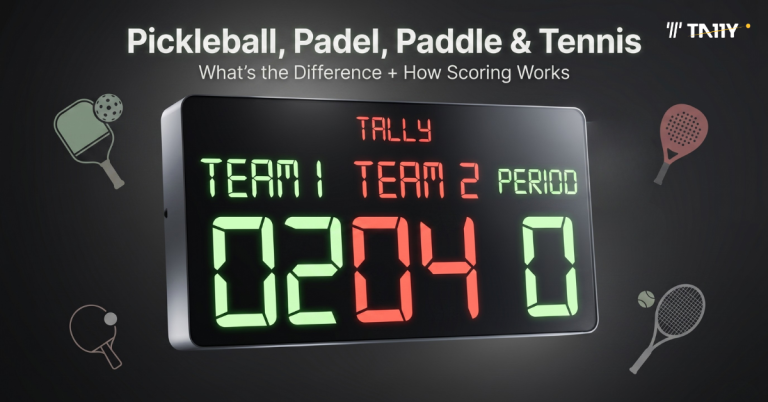
For a deeper side-by-side look at how these sports differ in scoring and setup, this breakdown of pickleball, padel, and paddle tennis differences and scoring is a useful reference to share with players beforehand.
Step 2: Choose the Right Format for Your Player Count
Format is everything. The wrong format leaves players sitting idle, creates lopsided matchups, or runs 90 minutes over schedule. Here’s how to choose:
Round Robin (Best for 4–12 Players)
Every team plays every other team. Best for social or mixed-skill groups where maximum play time matters more than a clear winner.
- Works well: 4–8 teams, 2–3 courts
- Games to 11 (pickleball) or one set (padel)
- Rank by wins, then point differential as a tiebreaker
Single Elimination (Best for 8–32 Players)
Standard bracket. One loss and you’re out. Fast and dramatic, but players can travel far and play once.
- Best for competitive groups or larger events
- Seed players by skill or use a random draw
- Plan a consolation bracket if you want more matches per player
Double Elimination
Lose once, move to the losers’ bracket. Lose again, and you’re out. Gives every team a second chance, popular for competitive club-level events.
Pool Play + Knockout
Divide players into pools of 3–4, play round robin within pools, then the top finishers advance to a knockout bracket. This is the sweet spot for 12–20 players and two courts.
| Format | Best For | Minimum Courts | Play Time Per Player |
| Round Robin | Social/small groups | 1 | High |
| Single Elimination | Competitive, large groups | 1–2 | Low to Medium |
| Double Elimination | Competitive, fair outcomes | 2 | Medium |
| Pool Play + Knockout | Mid-size mixed events | 2 | Medium–High |
Step 3: The 14-Player Tournament Rule And What It Actually Means
If you’ve searched for pickleball tournament guidelines, you’ve likely seen a reference to “the 14 tournament rule.” Here’s what it means in practice: USA Pickleball’s sanctioned tournament structure recommends a minimum of 14 players per bracket to ensure competitive balance across skill ratings, meaningful seeding, and enough match volume to determine a fair winner.
For most backyard setups, you won’t hit 14 players in a single skill bracket and that’s fine. The principle behind the rule still applies: don’t collapse multiple skill levels into one bracket without acknowledging the imbalance. If you have 10 players of genuinely mixed ability, consider a handicap format, a round-robin where wins are weighted, or simply splitting into two casual brackets of 5 with cross-bracket play.
The rule exists to protect competitive integrity. At a neighborhood event, what you’re protecting is the fun, so adapt accordingly.
Step 4: Set Up Your Courts and Logistics
Logistics is where well-meaning organizers lose control. A checklist approach helps.
Before the day:
- Confirm the number of courts and availability
- Send players a schedule with match times and format rules
- Decide on ball supply (new balls or shared)
- Set a rain contingency (postpone vs. covered courts)
- Create your bracket using a free tool like Challonge or a printed sheet
Day-of setup:
- Mark courts clearly (Court 1, Court 2) to avoid confusion
- Post the bracket or rotation schedule where all players can see it
- Designate one person as the scorekeeper/referee for disputes
- Set a consistent warm-up time (3–5 minutes per match is standard)
- Brief everyone on the format and tiebreaker rules before starting
Scoring logistics, this is the step most organizers underestimate. In a multi-court event with 8+ players rotating between matches, tracking live scores, updating standings, and settling disputes about who’s serving takes real attention. More on this in the next section.
Step 5: Running the Tournament Rotation, Disputes, and Keeping It Moving
The moment play starts, two problems will find you: players who don’t know when they’re on next, and score disputes that stall a match.
For rotation:
- Post the full match schedule in advance and update it after each result
- Use a whiteboard or shared notes app to update live standings
- Keep matches time-capped in round-robin formats (e.g., 20 minutes or first to 11)
For disputes:
- Establish the rule before the tournament: “If the score is disputed and cannot be resolved, replay the point.”
- Designate a court marshal (even a rotating one) who can be called over
- Encourage players to call the score aloud before every serve. This prevents most arguments before they start
How a Connected Scoreboard Simplifies Tournament Day
This is the point where most organizers wish they’d planned better. Running six matches across two courts, updating standings in real time, and keeping everyone informed of the current score creates real friction, especially when you’re also trying to play.
The core problems are familiar:
- Someone forgets the score mid-game, and the next serve becomes a debate
- Paper score sheets get lost or misread at the end of the day
- Players on Court 2 don’t know what’s happening on Court 1
- There’s no record of final scores once the tournament ends
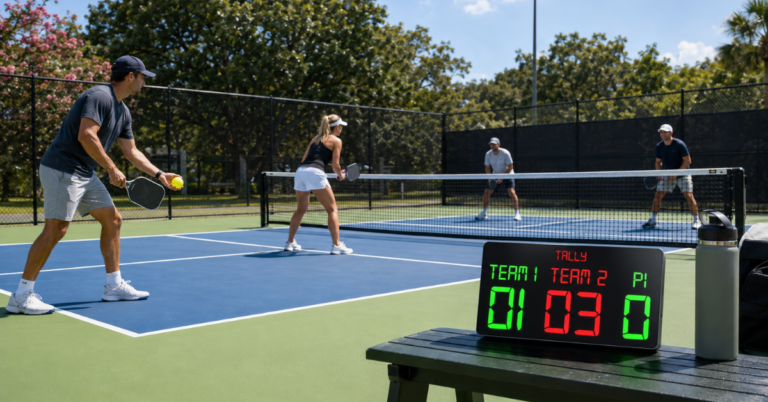
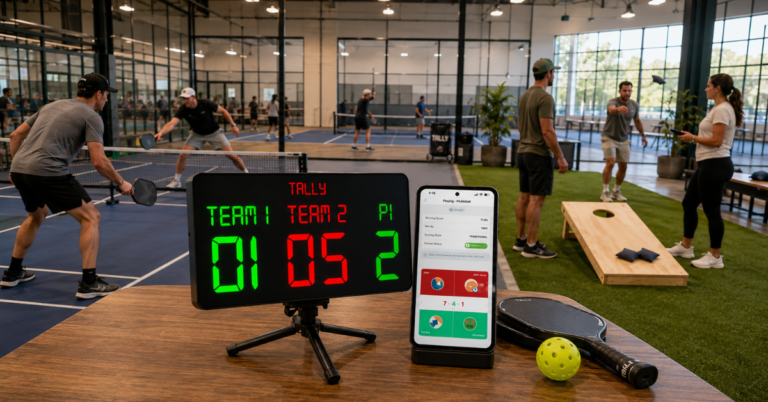
A portable, connected scoreboard removes most of this friction. Tally is a compact LED scoreboard that connects to your phone or Apple Watch via Bluetooth, letting you update scores from anywhere on the court without walking back to a table. The dual-color LED display is readable outdoors, and the companion app (iOS and Android) logs scores in real time and stores match history so you have a record of every result at the end of the day.
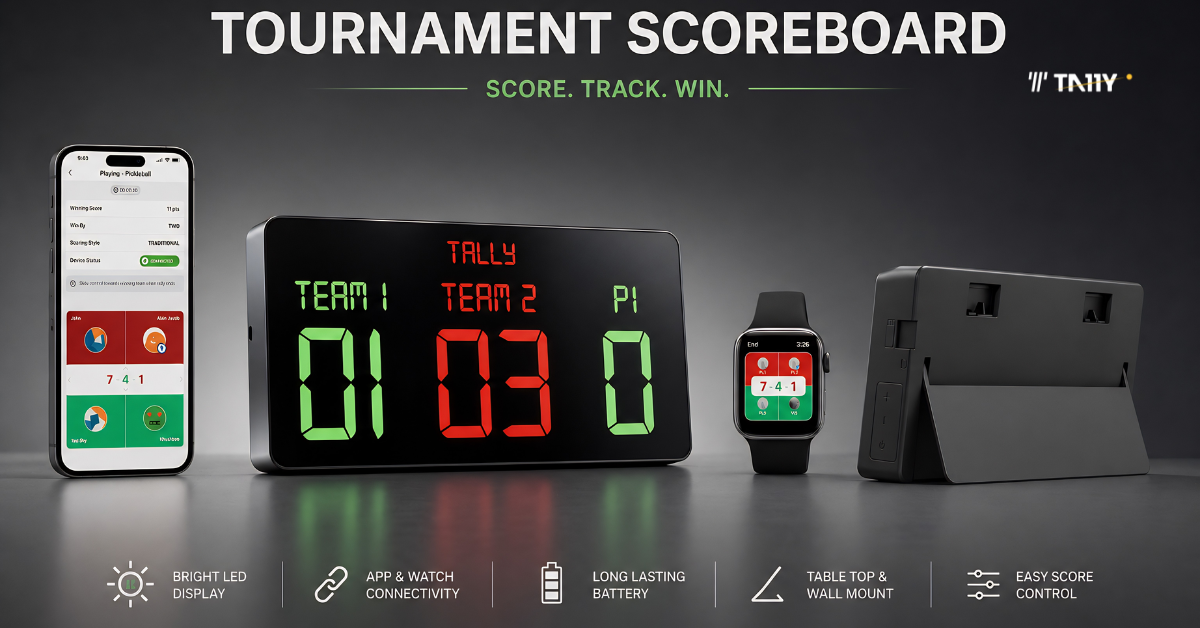
In a tournament setting, you’d typically set up Tally at each active court. The operator updates the score after each point from their phone, no paper, no shouting the score across the net, no “wait, what was it?” The app stores each match’s final score automatically.
For multi-court events, this matters more than it sounds. When one device can handle scoretracking for a full afternoon with nothing to configure between matches, it keeps energy on the court where it belongs.
If your last backyard tournament ended in a score argument or a lost bracket sheet, a portable scoreboard like Tally is a practical fix, not a luxury.
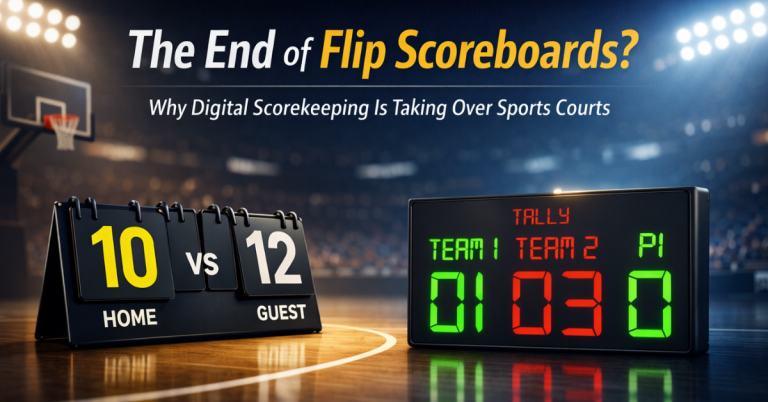
To see how manual scorekeeping compares to using a connected digital scoreboard across different game settings, this comparison of manual vs. digital scoreboards lays out the trade-offs clearly.
Conclusion
A great backyard tournament comes down to four honest decisions: how many players, which format, what scoring rules, and how you’ll track it all. Get the format right for your group size, post the rules before anyone picks up a paddle, and have a clear system for recording and displaying scores in real time.
The goal isn’t to replicate a sanctioned event in your driveway; it’s to give everyone competitive matches, minimal downtime, and zero arguments about the score. With a solid plan and the right tools, that’s entirely achievable before noon.
→ Want to stop mid-game arguments and start keeping clean records? See how Tally keeps every point visible and connected.

Team Tally is the collective voice behind Tally, covering topics related to scorekeeping, match tracking, and connected scoring technology for pickleball, tennis, padel, platform tennis, cornhole, and other points-based games. The team shares insights and updates focused on making scoring simpler, more accurate, and easier to manage during play.